The Formula and the Fire: Something Was Lost in 325 AD
The early church was not known for its doctrine. It was known for its behaviour. Something changed in 325 AD. The fire did not go out all at once.
March 23, 2026
Something happened in 325 AD.
Not all at once. Not dramatically. Not with a moment anyone could point to and say: there — that is where the fire went out.
But something was lost.
Before the formula
The early church was not known for its doctrine.
It was known for its behaviour.
Tertullian, writing around 200 AD, recorded what the pagan world said about the early Christian community: "See how they love one another."
Not: see how correct their theology is. Not: see how precisely they have defined the nature of their founder.
See how they love one another.
That was the reputation. The quality of life together. The way they treated each other and the world around them. The fact that they shared everything, cared for the sick and dying, welcomed the slave as a brother, the Gentile as an equal.
The fire was a way of living so different from the surrounding world that people kept asking what caused it.
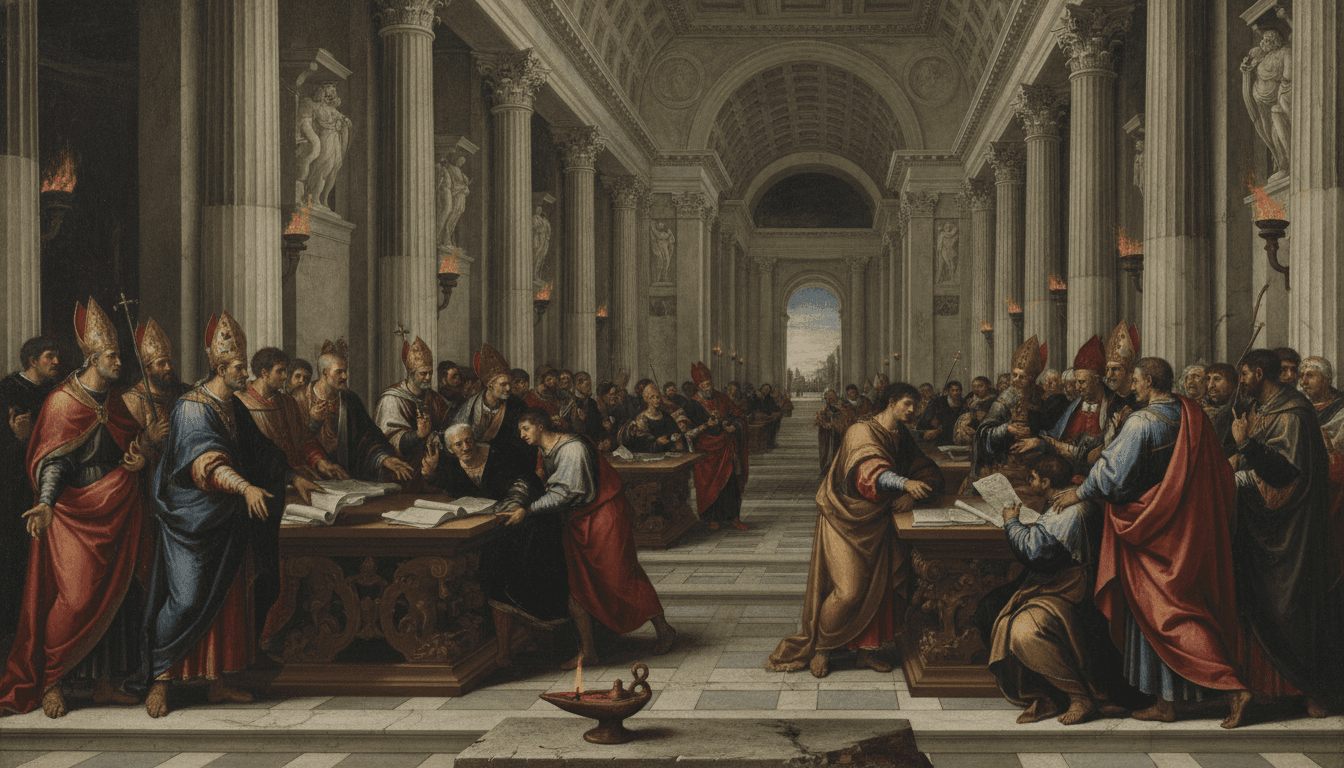
What the council was trying to do
Constantine had legitimate reasons for calling the council.
The church was divided. Arius of Alexandria was teaching that the Son was a created being. Athanasius was teaching that the Son was of the same substance as the Father.
The division was real. The theological stakes were genuine. The council was trying to settle something that mattered.
But in settling it, something else happened.
The test of belonging shifted.
Before Nicaea: do you follow the Way of Jesus? Do you live as he lived?
After Nicaea: do you hold the correct formula?
And slowly the declaration became more important than the life.
What was lost
The fire that the pagan world had noticed was not produced by doctrinal precision.
It was produced by a community that actually lived what it preached. That visited the sick. That buried the dead of the poor when nobody else would. That shared resources until none among them had need.
The formula did not kill that fire immediately. Many communities kept living it for centuries after Nicaea.
But the formula changed the centre of gravity.
The question that organised the community was no longer: how are we living? It became: what are we declaring?
The fire is still available
This is not a eulogy.
The fire that was present in those early communities is not a historical artefact. It is available right now. In any community that decides the question of how we are living is more important than the question of what we are declaring.
The formula was an attempt to protect the fire. The tragedy is that it sometimes became a substitute for it.
The question worth asking today is simple: which do you have?
Written by
Oliver T. Shepherd
Functional Faith — one question at a time.